
Bloomington Lookup Record Guide
No single hit completes a Bloomington resident lookup. A parcel result identifies a tax-roll owner, while a MyCase result identifies a party in a public court matter. Voter data has its own status and privacy rules. Vital records are event records, often available only to people who meet direct-interest rules. Start with the source that best fits the fact already known, then confirm the name in a second official system.
| Official record | Question it can answer | Custodian or portal | Access boundary |
|---|---|---|---|
| Parcel and tax roll | Who is listed as owner, and what parcel matches an address? | Monroe Assessor, Beacon, LowTaxInfo | Public current data; ownership is not occupancy |
| Court docket | Was this name a party in a public Indiana case? | MyCase and Monroe Clerk | Rule 5 exclusions and redactions apply |
| Voter registration | Can an identified voter confirm status or polling information? | Indiana Voters and Monroe election office | ACP, redactions, and request-use limits apply |
| Birth or death record | Did a covered event occur in Monroe County or Indiana? | Monroe Health or IDOH | ID, eligibility, age, and certified-copy rules |
| Business or license file | Does the person hold a filed public role or credential? | INBiz, UCC, PLA, Notary Search | A role or office address is not a home address |
| Historical index | Does a dated directory, obituary, deed, or probate lead fit? | MCPL, History Center, State Library | Coverage varies by year and format |
An address is best routed through the county parcel system. A legal name is often best tested in MyCase, then in a role-specific state search. A death date or family-history question belongs with Monroe County Public Library, the Health Department, or the State Library. If a portal lacks the needed year or document, contact the custodian instead of assuming there is no record.
Search Bloomington Names in MyCase
Indiana MyCase offers Case, Name, and Attorney modes. In Name mode, use the surname with a first or middle name and a date of birth when that field is lawfully available. Narrow to Monroe County, choose open or closed status, and set a filing-date range. Monroe instructions permit a wildcard after at least the first three letters of a surname. Sounds-like search can expose spelling variants, but it does not prove that two similar results refer to one person.
| Result field | How to read it |
|---|---|
| Case number | The stable reference for a Clerk request |
| Filing date and type | The time and category of the matter |
| Party role | How the name appears in that case |
| Docket | The dated list of filings, orders, and events |
| Public document | An available filing, which may still contain redactions |
A case header can remain visible when a document is sealed, withheld, or not digitized. Juvenile, mental-health, sealed, expunged, and some protection-order material may not appear. Monroe Circuit Court has nine divisions and handled 30,491 cases in 2024, so county and date filters matter. For a complete public file, ask the Monroe County Clerk what can be inspected or copied and provide the case number. Federal cases require the Southern District of Indiana and PACER, not MyCase.
Resolve Bloomington Same-Name Results
Common names are the chief trap in a resident lookup. Search with and without a middle initial, test known married or maiden surnames, and add a county, date, profession, parcel, or public business role. Never merge two people because their names look alike. An old address may also have a new street number, while a Bloomington mailing address can fall under a county or campus custodian.
- Write the name exactly as known, then list supported variants and suffixes.
- Anchor the name to a dated address, parcel, event, license, or case role.
- Compare source dates and jurisdictions, not just spelling.
- Record conflicts, exclusions, and the date each portal was checked.
A “no result” can mean the spelling differs, the year falls outside online coverage, the wrong county was chosen, or the record is confidential or not digitized. It is not proof that no event occurred. When an address becomes the main key, the Bloomington street directory explains the full parcel and deed route.
Verify Bloomington Resident Records
Verification means checking that the same person, date, place, and record role line up across independent sources. It does not mean collecting every available detail. For a Bloomington resident lookup tied to an address, the parcel system can supply the PIN, owner field, property address, and separate owner-mailing field. The court search can then test the name only when a court record is relevant. Vital and voter systems should be used within their own access rules.
- Search the Monroe Assessor or Beacon record and save the parcel ID, situs address, owner field, and search date.
- Compare the owner-mailing field with the property address. Describe a difference; do not turn it into an occupancy claim.
- Search MyCase with supported name variants, Monroe County, and a useful date range. Compare case role and filing date.
- Use a vital index, voter confirmation, license, or business filing only when that record type fits the question.
- Ask the custodian for the public image or certified copy when legal proof is needed.
- Docket
- A dated court list showing filings, orders, hearings, and other case events.
- Index versus image
- An index points to a record. The image is the document itself and may have separate access or fees.
- Certified copy
- An official copy authenticated by the office that keeps the record.
- Situs address
- The physical property address, which can differ from an owner’s mailing address.
Bloomington Voter Lookup Boundaries
The Indiana Voters portal lets an identified voter confirm registration, polling place, ballot, absentee information, and county contacts using name, date of birth, and county information. It is not a free-form list of people at an address. Indiana’s statewide system uses Pending, Active, Inactive, and Cancelled concepts, and a status change does not erase the underlying administrative record.
Public voter-record requests go through the county or state process and State Form VRG-24. The request agreement limits solicitation, resale, lending, and redistribution, while public files omit or restrict protected fields. Full Social Security numbers, citizenship-proof records, and Address Confidentiality Program information are not public. The Monroe County Clerk and election office are the local fallback when the public confirmation tool does not answer a lawful registration question.
Bloomington Vital Records Changed
Indiana changed a key birth-record rule on July 1, 2025. Birth and stillbirth records now become open after 99 years under IC 16-37-1-7.5. Some older library and agency guides still state the former 75-year threshold. Current law, current IDOH policy, and the custodian’s application rules control. Death records follow a separate 75-year and APRA framework, subject to other exceptions and issuance rules.
Monroe County Vital Records holds county birth and death certificates from 1882 forward and accepts eligible walk-in and mail requests. IDOH handles statewide orders, with no state walk-in service. An index hit does not entitle every requester to a certificate. Direct-interest proof, ID, county of occurrence, adoption law, and the record’s age can all control access. Check the live county page before paying because an older birth application shows a fee that conflicts with the current page.
Indiana’s Protected Family Search
A search for a birth parent or adopted relative should not use parcel, voter, or directory cross-references to bypass sealed records. The IDOH Adoption History Program provides the lawful route through the Adoption Matching Registry, medical-history registry, consent forms, contact preferences, and trained confidential intermediaries. Eligible relatives must document their relationship. A person must be at least 18 to register, while an adoptee must be 21 to request identifying adoption information.
Indiana adoption files remain confidential under IC 31-19. Consent or refusal by an adult adoptee and a birth parent’s contact preference can affect release. Non-identifying medical information follows a separate path. This is a case where fewer public searches produce the safer and more accurate result: use the state program, submit its forms and photo ID, and let its statutory process govern contact.
Confirm Bloomington Public Roles
Business and professional files can distinguish people with similar names when the public role is relevant. INBiz searches business name, filing number, registered agent, incorporator, governing person, street, city, and ZIP. The Indiana Professional Licensing Agency searches profession, name, license type, city, county, ZIP, number, and status. Notary Search accepts a name, county, or commission number. UCC records identify debtors and secured parties in filed transactions.
Keep each label exact. A registered agent, licensee, notary, UCC party, assumed-name filer, or parcel owner has a documented role as of a given date. None of those labels proves a present home address. The successful manifest image from the official PLA verification page shows the state route used to check a credential.
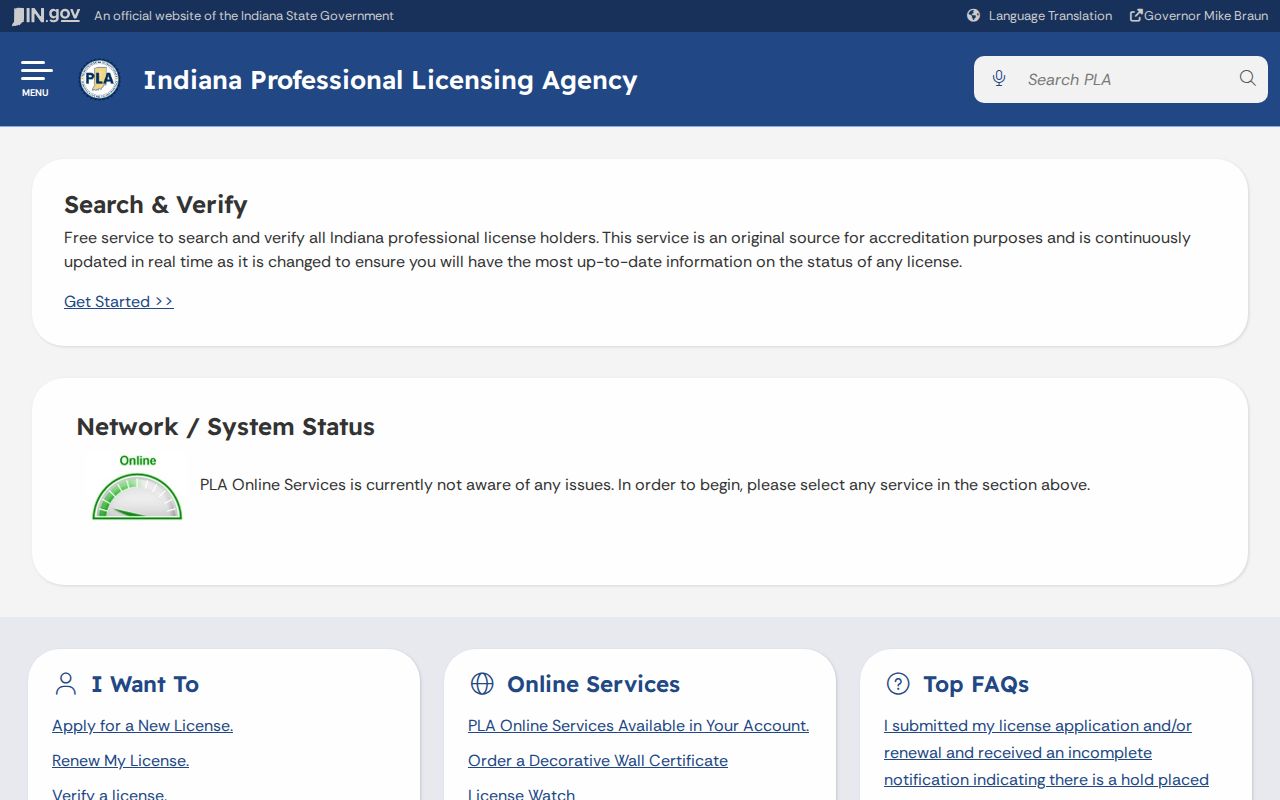
The result should be saved with its profession, license status, and search date, then compared only with other records that share enough identifiers.
Correctional records require a separate system. The Indiana Department of Correction Offender Locator is the official route for state custody information.
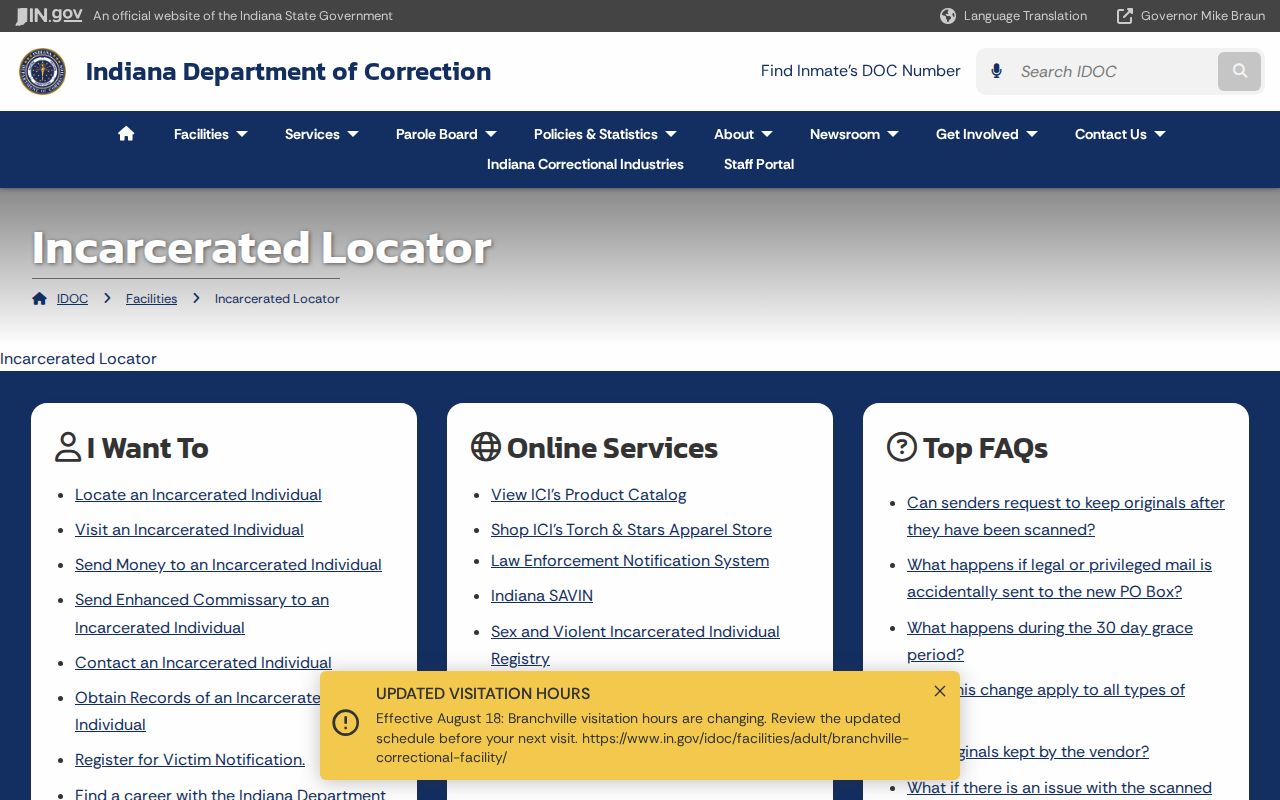
An IDOC result documents a correctional record, facility, or custody status. It does not establish a Bloomington residence, and Monroe County jail custody must be checked separately with the Sheriff or Correctional Center.
Lawful Bloomington Resident Lookup
Indiana APRA, IC 5-14-3, opens many existing government records but also requires or permits redaction and withholding. Ask for a defined record by name, date, case number, parcel, or event. An agency need not create a new resident list or answer an interpretation question. If access is denied, the response should identify the legal basis. Portal limits, fees, accounts, and vendor terms can still apply to otherwise public material.
Indiana’s Address Confidentiality Program supplies eligible survivors with a substitute mailing address for specified government uses. Covered voter name, address, phone, and identifying information can be confidential after proper notice. Do not combine public files in an effort to defeat that protection. Utility customers, driver records, sealed cases, protected vital files, and private household members also remain outside an ordinary resident lookup.
Lawful use. Use Bloomington records for lawful personal research, and never use a result to stalk, harass, intimidate, or expose a protected person.