
Bloomington City Directory Collections
The identified local run starts in 1900. The Monroe County Public Library house-history guide describes Bloomington directories from 1900 to current holdings. It places them in the Indiana Room under call number IND R 977.2 Bl. These books cover addresses inside city limits as those limits stood when each volume appeared. They are not one complete database.
Holdings overlap. Monroe County History Center newsletters identify 1900, 1907-08, 1909-10, 1916-17, 1920-21-22, 1922-23-24, 1925-26, 1934-1957, and 1952-1979 volumes. IU Archives and Wells Library also hold Bloomington books. Confirm an exact edition with the repository first.
| Collection | Years documented | Keeper | Access |
|---|---|---|---|
| Bloomington city directories | 1900-current identified; runs vary | MCPL, History Center, IU Libraries | Shelf, staff, and local research tools |
| Digitized directories | 1920-21-22; 1922-1923 | Indiana Memory and MCPL | Free images and transcripts |
| Telephone directory | 1951 identified | Indiana State Library | Indiana Memory images |
| Sanborn maps | 1883 through 1927-1937 sets | MCPL, IU, State Library, LOC | Online and microfilm |
| Newspapers and obituaries | 1827-recent index; title runs vary | MCPL and State Library | Index, film, and databases |
A missing year does not prove no book was issued. Ask the three local repositories, then bridge the gap with a close year, telephone book, census schedule, deed, or newspaper.
Bloomington Directories Online
Indiana Memory provides the clearest online foothold. Its 1920-21-22 Bloomington volume has images, transcript controls, and item metadata. A second item covers 1922-1923. These are selected volumes, not the whole city directory shelf.
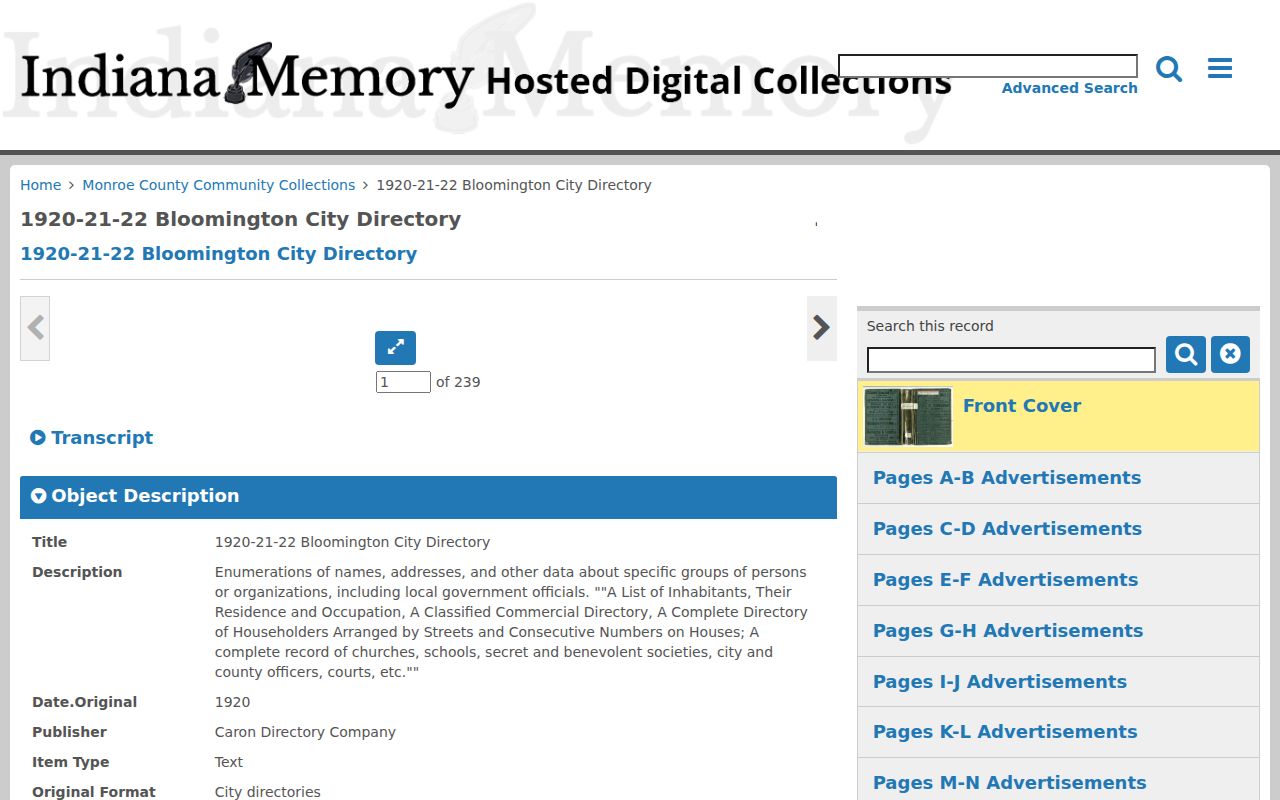
The viewer links a result to a scanned page. Save the title, year, page, and exact wording. The item credits Caron Directory Company as publisher and MCPL as repository. Its public-domain field does not remove the repository reproduction notice.
Transcript search is a fast first pass, but it does not replace reading the image. Old type, narrow columns, abbreviations, and scan quality can produce faulty text. Search a surname fragment, a street name, and alternate spelling, then open the page and inspect nearby entries. The alphabetic page controls can recover a listing that the transcript missed. For a citation, use the printed page and directory title, not just the viewer result number.
Reading Bloomington Directory Entries
A Bloomington city directory entry can be brief. Begin with the alphabetical list, then inspect the front matter and abbreviation key. The digitized 1920 volume describes inhabitants and residences, churches, schools, societies, officials, courts, and classified businesses. Marks can change between editions.
| Name | The listed person or householder, with spelling as printed that year. |
|---|---|
| Street entry | House number and street in the naming system then in use. |
| Telephone | A listed number when a subscriber appeared. |
| Householder order | People by street and consecutive house number in the 1920 volume. |
| Public role | Church, school, society, government, court, or business context. |
An entry shows what the publisher linked at that date. It does not prove legal ownership or present occupancy.
- Criss-cross method
- Reading street-ordered pages from an address to a listed name. No separately titled Bloomington criss-cross volume was found.
- Householder index
- A street and house-number list that lets an address lead the search.
- Abbreviation key
- The book's own list explaining short forms and symbols.
Bloomington’s 1900 Starting Point
History Center research reports no Bloomington directory earlier than 1900 had been located. Its holdings include a 1900 Residence and Business Directory. Thus 1900 is an archival starting point, not evidence that no earlier residents or records existed.
| Date | Research milestone |
|---|---|
| 1818 | Monroe County formed, with Bloomington as county seat. |
| 1900 | Earliest located local directory in cited research. |
| 1920-21-22 | Caron volume now online with transcript and images. |
| 1951 | Telephone directory digitized by the State Library. |
| 2024 onward | Beacon replaces old GIS directions for current parcel checks. |
For nineteenth-century people, use deed, marriage, probate, court, naturalization, newspaper, and census records. The State Library Monroe guide and History Center indexes are stronger than forcing a directory search beyond its years.
Bloomington Streets in Book Order
The 1920-21-22 description says householders are arranged by streets and consecutive house numbers. This feature can reveal who was listed along a block. Check the same number in nearby volumes because a person, building, or street number may change.
Historic Sanborn sheets add context. Bloomington coverage is documented for 1883, 1887, 1892, 1898, 1907, 1913, 1927, and 1927-1937. Maps may show footprints, material, use, street width, blocks, and house numbers. They explain the site while city directories supply dated listings.
Plat maps supply another layer. MCPL identifies Monroe County plat editions from 1856 and many later years through 2010. Plats emphasize owners and land boundaries, often beyond the city limits of the publication date. A name in a plat therefore has a different role from a name in a directory. Compare the street listing, map year, and deed description before concluding that an old address and a modern parcel are the same site.
Bloomington Indiana Room Research
The MCPL Indiana Room, 303 E Kirkwood Avenue, keeps the Monroe County Index, obituary index, maps, community collections, yearbooks, newspapers on microfilm, family histories, plat maps, and clipping indexes. Call 812-349-3050 or email indianaroom@mcpl.info. Appointments are encouraged but not required. Free scanning is available.
Bring an exact name or address, date range, and old street form. Ask which shelf, reel, database, or archive fills a gap. The History Center, State Library, and IU may have another edition or companion source.
Tracing Bloomington Family History
Follow a household through several years. A directory narrows the time between federal census schedules and shows when an address or phone listing changed. Census records, deeds, probate, and obituaries test what that shift meant.
- Find the surname and copy the full entry, title, year, and page.
- Check one volume before and after it, noting spelling, address, phone, and role.
- Use street-ordered pages to confirm the house number and nearby listings.
- Pair the listing with the closest census, then test ownership in deeds.
- If the name vanishes, check obituary and probate indexes before drawing a conclusion.
A person may have moved, died, used another spelling, lived outside the publication boundary, or simply gone unlisted. Keep each option open until a dated record resolves it.
Deeds Beside Bloomington Directories
The History Center combined grantee index reaches 1811-1926, while Doxpop online documents begin in January 1991. Older records and full instruments route through the Monroe County Recorder. A directory names a historical listing; a deed records a transfer or instrument.
Start with the old address, identify the modern parcel and legal description, and search deeds by party. Changed lots and street numbers can defeat an address match. The full current process belongs in the Bloomington street directory. Keep a historic listing separate from ownership.
The early index reaches 1811, seven years before Monroe County was created. That date can matter for land whose paper trail began under predecessor-county arrangements. Treat the index as a pointer to grantor, grantee, date, and recorded instrument. The complete deed can carry the legal description needed to connect the older tract to a later Bloomington address. If an online name search begins too late, ask the Recorder or History Center for the older index route rather than assuming the chain ends.
Bloomington Archives Beyond Directories
Monroe County History Center keeps court, probate, deed, obituary, tax-duplicate, and vertical-file resources. Indiana State Library offers Indiana Memory, Indiana Legacy, Hoosier State Chronicles, cemetery and biography indexes, county histories, and library newspaper tools. IARA Research Indiana filters land, court, naturalization, military, coroner, business, and other series.
Use open images when present, ask local staff, visit shelves or film, or order copies under repository rules. A Research Indiana hit may point to a box or reel rather than an image. Original deeds remain with the Recorder. Original court and probate files route through the Clerk under access rules.
Historical event indexes are leads, not certified records. State Library research describes Monroe birth WPA material for 1882-1920, death indexes for later spans, segmented marriage holdings, historic court files, and naturalization collections. The custodian changes with the record. Certified marriage and court records route through the Monroe County Clerk, while restricted birth and death certificates route through Monroe County Health or the Indiana Department of Health under current eligibility rules. This split matters when a city directory gives a name but no clear reason for a disappearance.
Obituary work also benefits from exact dates. MCPL provides a county obituary index and newspaper microfilm, while the State Library maintains a large Indiana newspaper collection and free Hoosier State Chronicles access. Its research guidance asks for the full name, married or maiden name, and death, burial, or funeral date when possible. A listed State Library obituary copy costs $5. If no complete online run exists, contact the library for the title and reel that covers the date instead of assuming the notice was never printed.